
The Eisenhower Matrix for Founders: Prioritise What Matters

When life as a business owner gets too complex, and it often does, rapidly, I go back to one sheet of A4 paper.
I use it with my coaching clients, and I use it on myself. It takes two minutes to draw and it has rescued more of my weeks than any app I have tried.
It is often called the Eisenhower Matrix, after General Dwight D. Eisenhower, who is said to have organised his work around two questions. How urgent is this? And how important is it?
When everything feels urgent, the answer is rarely to work faster. It is to put it on paper.
How to draw it
Take an A4 sheet and draw a cross down the middle. Across the top, write urgent and not urgent. Down the side, write important and not important. You now have four boxes.
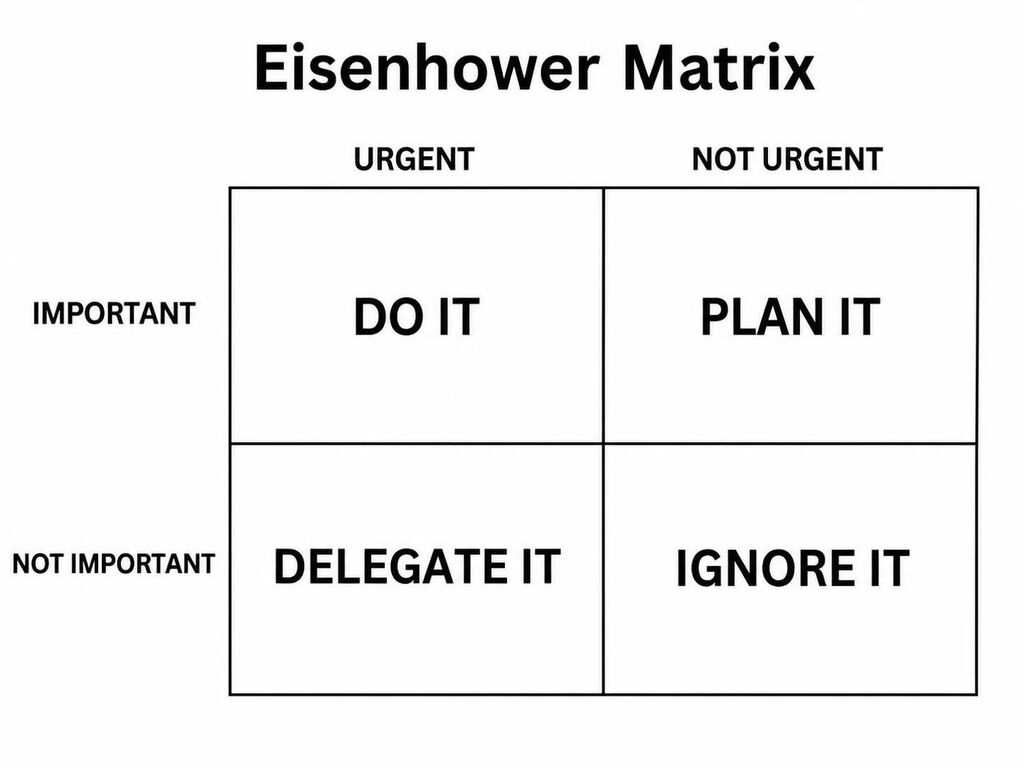
Then write every task, request and worry you are carrying into one of the four boxes.
Box one: urgent and important. Do it.
These are the things that genuinely cannot wait. If the house is on fire, you leave. That is urgent and important.
Here is the surprise for most founders. If you are running your business and your life with a plan, this box should not be very full. When it is overflowing week after week, that is usually a symptom, not a workload. Things are arriving in the urgent box because nobody planned for them while they were still in the important one.
Box two: important but not urgent. Plan it.
This is where high performance lives.
Strategy. Your health. Your closest relationships. The hire you need in six months. The conversation with your investors that is easier now than next quarter. None of these shout, which is exactly why they get pushed aside.
The answer is to put them in the diary, and be meticulous about it. Block the time and protect it as you would a client meeting. Some of the most visible leaders in the world are known for blocking their days in this way, giving focused, undivided time to each priority. When I block time for the things that matter, magic tends to happen. When I do not, they drift.
I will admit I am not playing enough golf at the moment. It is not because I am too busy. It is because I am not blocking the time.
Box three: urgent but not important. Delegate it.
This box is full of things that feel pressing but do not need you. The request that arrived five minutes ago. The approval that has never once been refused. The meeting that exists because it always has.
Delegate them to your team, or to other people in your life. They may not do it exactly as you would. That is usually fine, and the time you gain is worth far more than the difference.
Box four: neither urgent nor important. Ignore it.
This is the easiest box and the hardest to act on. If something is neither urgent nor important, let it go. Throw it away. Forget about it.
Most founders find that the simple act of naming these things takes away much of their pull.
What a calm diary tells you
The goal of the matrix is not a perfect list. It is a different feeling.
When you are genuinely on top of things, the urgent box is small and the planning box is full. Your days feel almost calm. You may even find yourself in something close to a flow state, working on the important things at a measured pace rather than reacting to whatever arrives next.
That calm is not a sign that you are doing too little. It is often a sign of high performance at its best.
Why founders find this harder than most
Founders are trained by the early years to live in box one. Everything was urgent because the business depended on you, and responding fast was how you survived.
The trouble is that the habit stays long after the business has grown. You keep firefighting because firefighting is what built the company, and the business quietly organises itself around the assumption that you always will.
The matrix breaks that pattern by making it visible. It is very difficult to look at a sheet where box one is crowded and box two is empty and still believe you are running the business strategically.
A five-minute weekly habit
You do not need to redraw your whole life. Try this once a week.
- On Monday morning, draw the cross on a fresh sheet.
- Write down everything on your mind and place each item in a box.
- Move at least one item from box one into the diary as planned time for next week.
- Delegate one item from box three before lunch.
- Cross out everything in box four.
Repeat it for a quarter and look at how the balance between the boxes has changed.
Simplicity is the advantage
Life is complex, and it is only getting more so. The leaders who thrive are rarely the ones with the most sophisticated systems. They are the ones who can break complexity down into something simple enough to act on.
A sheet of A4 and a cross down the middle may be the simplest tool you ever use. It may also be one of the most valuable.
What would go in your top left box today?
If everything feels urgent at the moment, a Clarity Session may help. I would love to hear your thoughts on this. Do touch base with me.

